


Toledo Travel Guide: Why it's more than just a day trip

Updated: Sep 19
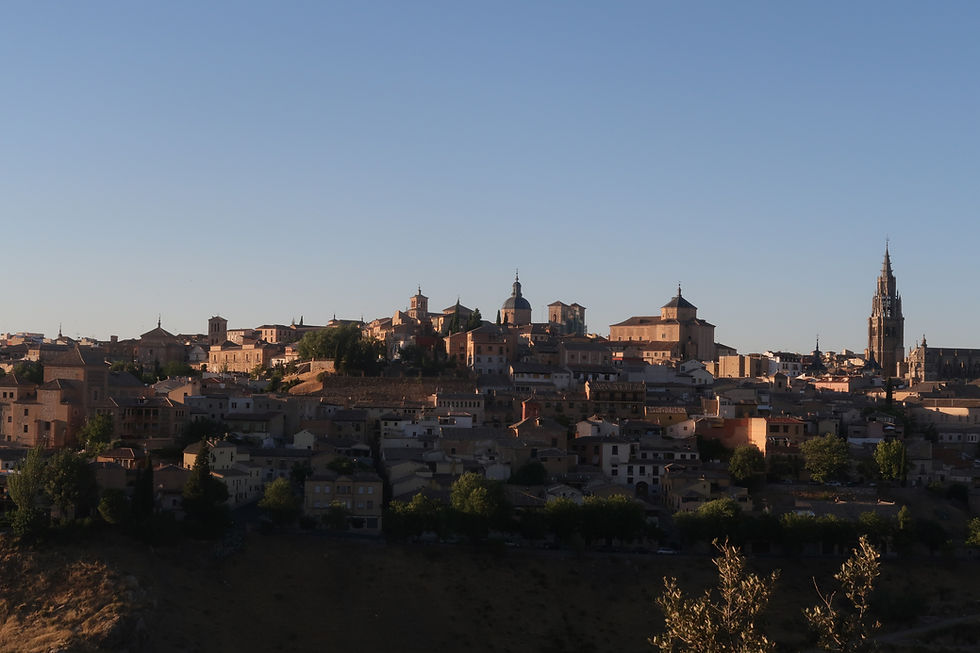
It’s early morning on Paseo San Cristóbal. A warm breeze rustles the leaves overhead, and dappled sunlight casts dancing shadows along the tree-lined promenade. I sit on one of the ornate tiled benches, admiring the glorious views of the Judería and the Old Town. A person could never tire of that sight: golden-hued buildings infused in a soft morning light. A series of tall, elegant cypress trees stand like punctuation marks between the buildings, topped with a cloudless blue-sky. Swifts dart in and out of buildings in graceful, synchronised movements while tiny sparrows hop between benches in the hope of some discarded crumbs.

A few elderly locals are getting their steps in, walking up and down and greeting each other with a friendly buen dia. They smile at me and sometimes I get a buen dia too. The women are beautifully decked out with perfectly styled hair, elegant jewellery and a slick of lipstick. Like the Italian passeggiata, this is not just about fitness. It’s time to see and to be seen.

It’s peaceful at this time of day. I lose track of time and realise I’ve been sitting here for almost an hour. Life in this small city has taken on a lazy, languorous pace. It’s a pleasure to have four slow days to absorb its character and find its soul.
Toledo has long been a popular day-trip destination, benefitting from frequent high-speed train connections from Madrid, a journey of just over half an hour. But with convenience comes a lack of deeper connection, with day-trippers missing out on those quiet moments of early morning beauty, and the sublime light that settles over this ancient city at sunset. Toledo is a worthy destination, deserving of a longer stay.
Disclosure: some of the links on this site are affiliate links with companies I have chosen to partner with. If you make a purchase through these, I may receive a small commission at no extra cost to you. Thank you for your support!

Contents:
Where to stay in Toledo:
We check into our hotel which turns out to be the former palace of the Empress Eugenia de Montijo. A 5-star hotel without the hefty price tag, this was everything we wanted for our four-night stay – plush comfortable rooms in a superb location, right in the heart of the historic centre.
We’ve booked a superior king room: absolutely worth the extra money if you’re planning on spending a few days. Ours is large and bright with a huge and luxuriously comfortable bed; its walls painted a calming shade of jade. We sleep like logs every night - 10/10 for extreme comfort.
A decent-sized bathroom with ‘his and hers’ sinks and deliciously scented natural bath products add to the sense of quiet luxury, while monogrammed towels and bathrobes tell us that we’re somewhere a little bit special.
An old-fashioned writing desk in the bedroom is one of my favourite features for scribbling notes and observations after a day’s explorations. Small details like a yoga mat are very much appreciated - perfect for stretching out after a long day's walking in the heat.
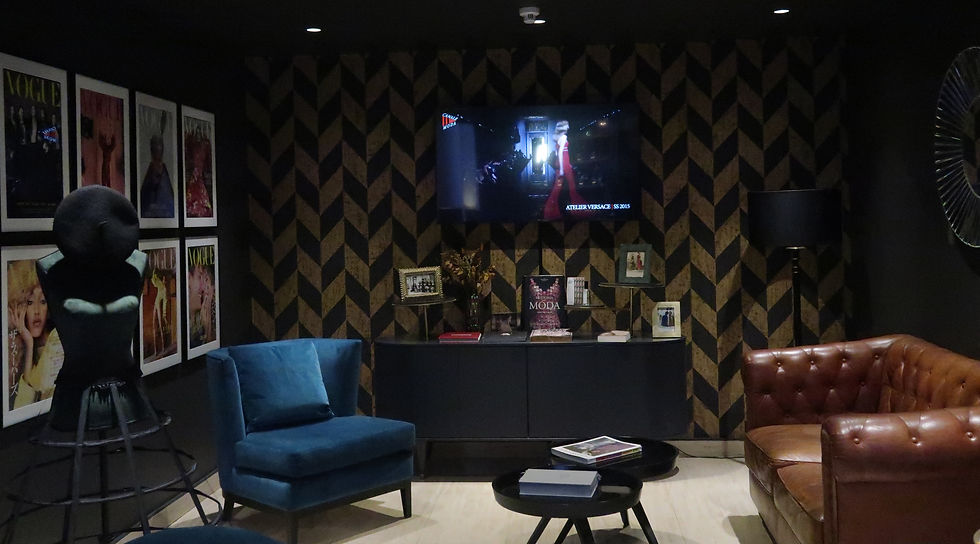
Staff are one of the hotel’s greatest assets. On arrival after a long day’s travelling, the receptionist is attentive and helpful, with plenty of advice on where to go and what to see in the area. My Spanish is rusty and I’m in need of some practice but she’s kind and doesn’t immediately switch to English, saying she’ll speak slowly. I’m amazed how much I understand, and it gives me courage to continue when we’re out and about in the city.

The décor is beautiful and the hotel has retained much of its historic detailing. The bar deserves a mention with tiled floors, and a stunning stained glass domed ceiling. They serve great cocktails too.
My only gripe is car parking. On-street parking is not permitted for non-residents in the historic centre of Toledo, and garages take full advantage. It’s €22 per night to reserve one of the hotel's parking spaces, or parking is available in Santo Tomé parking lot at €19 for 24 hours.
Tip: there are cheaper options on the outskirts of the city. Safont car park is beside the bus station and has a rate of €9 per day. It’s worth noting that there is an escalator running from the bottom of the steep river valley beside the car park all the way up to the Palace of Congress – an absolute lifesaver during a heatwave, saving ourselves a 15-minute uphill hike back – location here.
Eugenia de Montijo, Autograph Collection, Pl. del Juego de Pelota, 7
Why Toledo is worth visiting

The rich history of this ancient city has left an indelible mark on its streets and buildings. Set high on a rocky mound and surrounded on three sides by the river Tajo, the entire city is a UNESCO World Heritage Site. With a long history of Jews, Moors and Christians living and working peacefully alongside each other, its striking Mudéjar architecture bears testament to this, fusing elements of all three cultures. It’s a pleasure to wander the narrow, cobbled streets of the old town, admiring the intricate details of its stonework, doorways, balconies and hidden courtyards. The Islamic influence is particularly strong, with elegant tile and brickwork, and appealing geometric patterns.
What to see and do: Toledo Travel Guide
Drink in the panoramic city views from Mirador del Valle and Mirador de Toledo

On a balmy evening, we drive to the outskirts of town for the optimum viewing point of the city. It’s approaching sunset at Mirador del Valle, and the full expanse of the city is before us, bathed in a golden light. It’s an extraordinary sight with some epic sweeping views of the valley – from here you really get a sense of the unique geography of the city. Buildings appear to be stacked on top of each other, with the Alcázar at the top dominating the landscape.

Further along, Mirador de Toledo offers a slightly different perspective of the valley, and the southwestern edges of the historic centre.
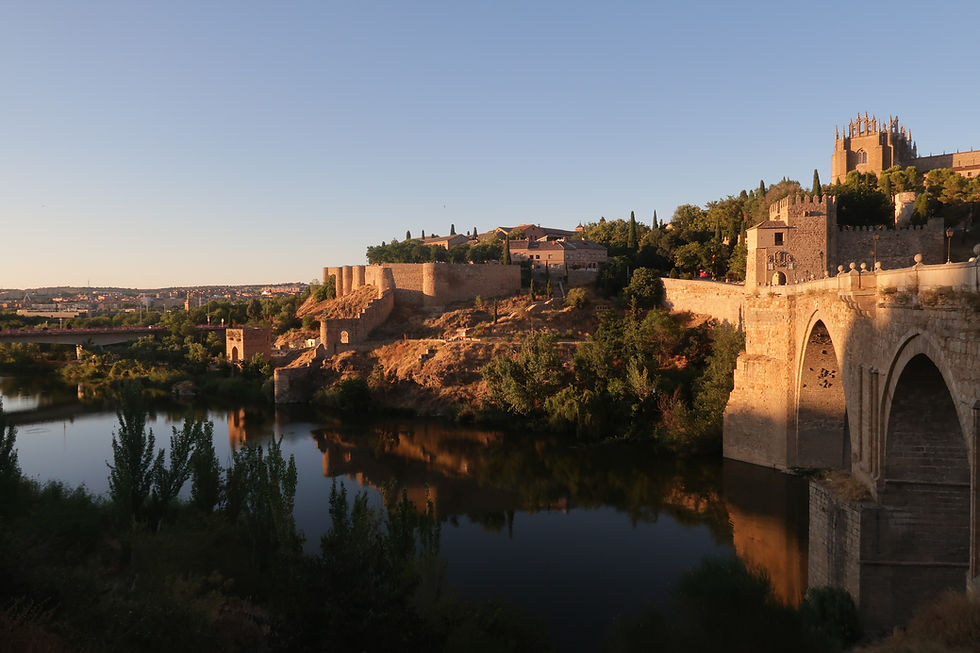
Circling back around to town, we pull the car to a sharp halt at yet another spectacular view. Rounding a corner, the monumental fortifications of the old town and the pale stone arches of Puente San Martín come into view, reflected in the water below. The sky is a perfect cloudless blue, the riverbed lined with banks of lush greenery and purple flowers, the buildings seeming to emit a golden glow from within. It’s jaw-droppingly beautiful.
Toledo Cathedral: a treasure trove of art and architecture

Every great city has a cathedral, but Toledo’s is unmissable. Monumental doesn’t even begin to describe it, with twelve unique chapels. Construction started in 1227, but it unsurprisingly took 250 years to complete.
There is a lot to take in, but here are just a few of the highlights, starting with the magnificent 15th and 16th century-stained glass windows, and two rose windows over the north and south doors.
The coro (choir) stands at the heart of the complex and is something very special with two tiers of carved wooden stalls showcasing countless fantastic details.
On the lower register are a series of carvings in walnut from the late 15th century. With panels featuring scenes from the conquest of Granada, each one shows a different village taken by the Christians. Fantastical figures and animals are carved into the ends of the stalls – I particularly loved the monkey lazing nonchalantly on the corner of a bench. On the upper register are a series of prophets, martyrs, and biblical figures, with a throne at the centre.
But the greatest surprise is yet to come. M appears around a corner; announcing he’s seen one of the greatest paintings of his life and beckons me to the sacristy. It’s a Goya, no less, his interpretation of the Taking of Christ. It’s superb: poignant and filled with emotion.
And then I find myself face-to-face with Titian’s Paolo III. It’s staggeringly good with eyes that seem to look deep into my soul. I can’t look away.

And in the next room I fall in love with El Greco. Toledo became the adopted home of the Mannerist painter and is where he lived and worked for the last decades of his life. Until this trip, I’d seen only a handful of his large religious paintings. After four days in Toledo, he became one of my favourite artists and this was my first introduction. In the sacristy stands an entire room of his portraits and none are behind glass, allowing for a more immediate experience. I stare at his paintwork and follow his brushstrokes. They are utterly extraordinary, deeply affecting and so very human.
Toledo: a permanent homage to El Greco

One of the most popular places in Toledo is the wonderful El Greco Museum, celebrating the life and work of the city’s adopted son. Located in the Jewish Quarter (the Judería), the museum houses a key collection of works from the painter's late period, when he produced what is arguably the best work of his life.
A particular highlight is his series of paintings of the 13 apostles. Each portrait is unique with their own distinct characteristics; each one extraordinarily human and deeply affecting. In The Tears of Saint Peter, his eyes hold so much sadness and regret. The depth of emotion achieved in paint is remarkable.
The museum also benefits from a tranquil leafy garden with seating area beneath the trees. It’s incredibly peaceful with nothing but the sound of birds and some very noisy cicadas. All this for a mere €3 entrance fee.
El Greco Museum, P.º del Tránsito, s/n
Around the corner in Iglesia Santo Tomé we find El Greco’s fascinating altarpiece The Burial of the Count of Orgaz. The monumental canvas is divided into two distinct sections, the heavenly and the earthly, differentiated by style and the use of light and colour. Among the figures on the lower register, look out for his own self-portrait among the series of heads. He also includes his young son on the bottom left.

Iglesia Santo Tomé, Pl. del Conde, 4
Victorio Macho: An unmissable small museum with scenic views

Museo Victorio Macho is a treasure of a museum, hidden in plain sight. On a hill overlooking the river is the idyllic location of choice for sculptor Victorio Macho to build his house and workshop in 1953.
The collection showcases 91 sculptures and 48 drawings from various artistic periods of his life, housed in a showstopping location. A leafy terrace is home to a beautiful sculpture garden - a peaceful place, dotted with trees, plants and sculptures. Birds and butterflies flit across the courtyard, cicadas are noisily making their presence known as a welcome breeze whistles through the overhead leaves. On this sunny afternoon, we are the only visitors.
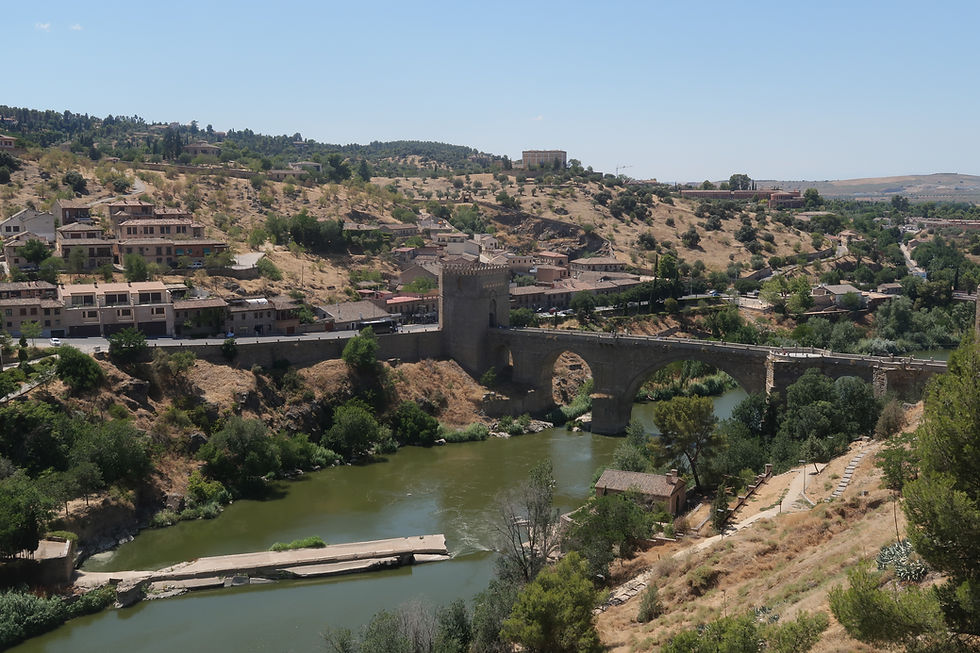
A series of bronze busts line the railing of the viewing platform which offers some truly stunning views of the river, the valley and of the iconic stone bridge, Puente de San Martín. The best views are from the upper-level platform, bookended by two bronze heads, their faces raised to the sky.

The small museum houses a mix of drawings and sculpture. A wall is lined with portraits of his family members and friends. Of note is a poignant sculptural tribute to his mother, and his self-portrait as a grumpy 17-year-old. It’s an unmissable place to visit – one of our highlights of Toledo.
Museo Victorio Macho, Pl. de Victorio Macho, 2
Toledo’s rich history in its buildings and monuments
A mingling of Jewish, Arab and Christian cultures in Medieval times has contributed to some of the city’s most striking architecture. The Judería is our favourite part of the city, its narrow streets lined in pale stone buildings in a distinctive Mudéjar style. Façades are adorned with elegant tile and brickwork in ornate geometric patterns.
Sadly, the peaceful coexistence of cultures came to an end from the late 1470s with the instigation of the Spanish Inquisition under Queen Isabella I and King Ferdinand II. By 1492 all Jews and Muslims had been expelled from Toledo.
I spend a morning in the Jewish Quarter, detouring through its picturesque backstreets, absorbing in all its small details. Sinagoga de Santa María La Blanca is one of just two synagogues still standing in Toledo today.
The 13th century interior is pared-back and beautiful: gleaming white walls on the lower level allows the intricate ornamentation on the upper level to shine. Four rows of octagonal pillars support a series of horseshoe arches, with elaborate and intricate geometric designs. Rich red floor tiles are a striking contrast. It’s a calming contemplative space.
Sinagoga de Santa María La Blanca, C. de los Reyes Católicos, 4
Close by is the 14th century El Transito synagogue. The Islamic influence is evident in its decorative scheme – a long rectangular hall with fine tracery windows boasts a striking feature wall of polychrome floral and geometric motifs, and inscriptions in Hebrew and Arabic.
El Transito was converted into a Christian church after the expulsion of the Jews but was later designated a national monument in 1877. Ticket price also covers entry to the attached Sephardic Museum.
El Transito, Calle Samuel Leví s/n
There is something quite special about the Taller del Moro, Workshop of the Moors. It’s free to visit and reminiscent of a miniature Alhambra.
Dating to the 14th century, it’s yet another fine example of Mudéjar architecture with a striking wooden ceiling and panels of intricate carved plasterwork including hundreds of stylized, cone-like motifs, common in Islamic architecture.
Taller del Moro, C. Taller del Moro, 3
Monasterio de San Juan de los Reyes is an imposing 15th century Gothic structure conceived as a burial place for the reigning Isabella and Ferdinand (this never comes to fruition, and they are buried in their ultimate conquest, Granada).

The location choice was undoubtedly a provocative one – a Catholic monastery in the heart of the Jewish quarter – a final nail in the coffin for the Jewish faith in Toledo.
It’s worth visiting for the stunning double-level cloister alone: an arcaded walkway enclosing a lush and serene garden. The level of sculptural detailing is fantastic – Gothic downstairs and Mudéjar upstairs – with fantastical creatures, gargoyles, animals and geometric motifs. It’s also worth noting the superb series of sculptures of saints on the lower level. Unusually many of these figures are women.
Renovation work revealed ancient frescoes which are now on show to the public in the sacristy.
Monasterio de San Juan de los Reyes, C. de los Reyes Católicos, 17
Leaving the Jewish Quarter, it’s worth visiting La Mezquita del Cristo de la Luz, the city’s only remaining mosque from an original ten. A tiny structure featuring both Muslim and Christian iconography, it was formerly a mosque before its conversion to a Christian temple after the reconquest of the city. Dating to the 10th century, it’s one of the oldest and best-preserved monuments in Toledo.

Terracotta-coloured stone, ochre tiles, a tranquil garden and a central water feature combine to create a restful, harmonious space synonymous with Islamic design. The garden is lush and green with a symphony of plants and rose bushes bringing colour and fragrance.
A terrace offers some fantastic views of the city with a birds-eye view of its old city walls and Puerta del Sol, one of its original city gates.
La Mezquita del Cristo de la Luz, C. Cristo de la Luz, 22
Visitors to the city cannot fail to be impressed by the magnificent city gates which are still in remarkable states of preservation. From Puerta del Cambrón, we stroll the leafy walkway through Parque Recaredo, a much-needed reprieve from the glare of the afternoon sun, following the path of the original city walls.
Close by are two significant monuments. The Gate of Alfonso VI, also known as The Old Bisagra Gate, dates to the 10th century and was an original entry point to the city during the time of Muslim rule. It features all the motifs we’ve come to recognise from the Mudéjar tradition: horseshoe arches and elegant brickwork.
Through the arch is the peaceful Plaza de Alfonso VI. Here we find 'Lugar de Encuentros V' (Meeting Place V)”, an elegant abstract sculpture by renowned Basque artist Eduardo Chillida. Despite its modernity, the cool colour palette sits perfectly within its historic surroundings.
Puerta Nueva Bisagra today is the grandest entrance point to the city, replacing its older predecessor. Also of Moorish origin, it was built during the 16th century in the Renaissance style. In size it more closely resembles a castle with two towers connected by a triumphal arch. It’s a seriously impressive structure.
Eating and drinking in Toledo

Visitors looking for a vibrant nightlife may be left wanting in Toledo. Even at the height of summer, many places close early, and the city streets are often silent by 11:30.

Having less options to choose from has its advantages. We gravitate towards La Malquerida de la Trinidad on our first evening, and it quickly becomes our go-to place for a casual lunch, a leisurely dinner or a nightcap. Staff are friendly, the atmosphere is buzzy and drinks are great value, with an excellent Rioja for a mere €3. They’ve come to recognise us after a few days.
We’ve arrived on match night – Spain v France in the World Cup Semi-Final. Understandably tensions are high. Two older men sit propping up the bar. They’ve clearly been there for some time and are making their way through glass after glass of vino rosado while intermittently yelling insults at both the referee and the French players. We breathe a sigh of relief when they win. And just like that, we've found ourselves a local.
The next day we come back for lunch. It’s a popular spot with a broad menu serving everything from Poké bowls to toasties to huge salads. Young staff are attentive and friendly and while it’s a casual spot, the service is great – our young waitress balances a tray on one arm with a bottle of red and one of white, and two glasses, expertly pouring a glass of each without spilling a drop.
It’s also a popular place for evening tapas. Portions are generous and great value, and they have no issues in telling you if you have over-ordered. It's nothing fancy – just simple food made well. The croquettes are particularly good, and I have a soft spot for their free snacks - basil pesto, feta and tomato on crostini.
On our last night, we pop in for a farewell drink. It’s worth pointing out that the main barman makes a mean G&T. Hendricks, cucumber, dried lime, lashings of ice and in true Spanish style, a free-pour of gin. He takes his time and it’s a real work of art.
Over our four days here we note a familiar cast of characters. They’re all local and greet each other by name. There’s our football-loving friend nursing his usual glass of rosado. The night before he was holding court to anyone who would listen. Tonight he’s unusually subdued, like a Spanish poet weeping in the corner.
At the bar we spot another familiar figure – a young shaved-headed man sitting in his usual spot - on a high stool facing the vermut tap and sipping a vino blanco with a backpack on his back. It never comes off. He never speaks except to order his drinks and just stares straight ahead. We’re intrigued and have conjured up all sorts of backstories.
La Malquerida de la Trinidad, C. Trinidad, 2

El Trebol cerveceria is another hugely popular spot for drinks and casual dining. It’s a muggy evening, still hovering around the late 30s, and a cold beer after a long day’s travelling makes the world a better place almost instantaneously.
While the locals are sensibly seated indoors in the air-conditioned bar, it’s the first day of the trip and we opt to sit on the terrace, absorbing the sights and sounds of the city. We’re served by a smiley young man who seems to have no issues in understanding my rusty Spanish. A tapas menu offers simple, hearty food at a great price and I order the first of many Ensaladilla Rusa of this trip. It’s delicious and I have to restrain myself from licking the bowl.

Tiny sparrows hop lightly beneath the tables hoping for some crumbs. A small child throws half a baguette at them, and they struggle to tear it apart. After a day or so, we start to notice these little creatures everywhere in Toledo.
El Trébol, C. de Santa Fe, 1
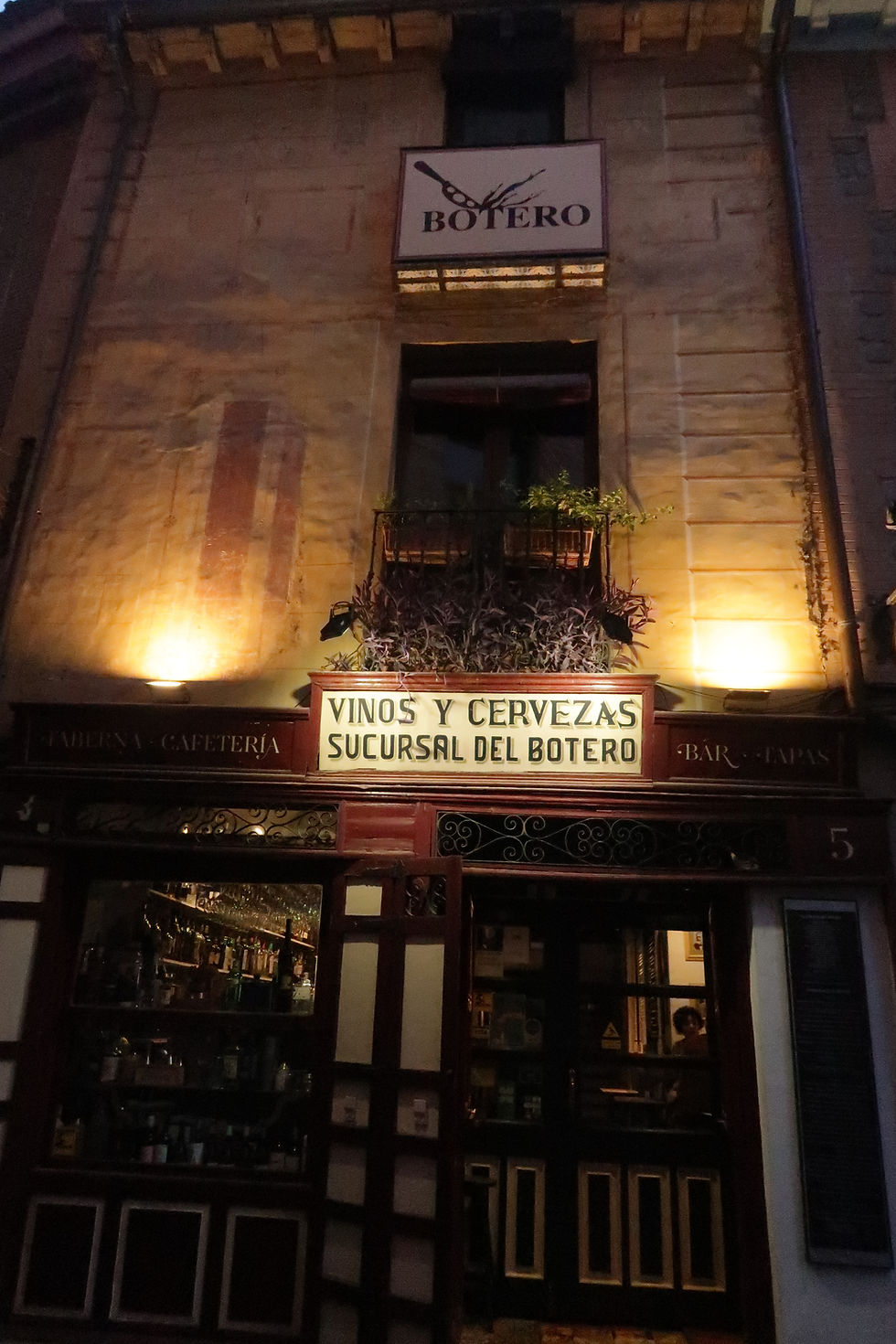
Dinner at Taberna Botero is our first formal meal in Toledo. We’d heard good things and it doesn’t disappoint. Downstairs is a casual traditional bar. On this particular evening, the atmosphere is lively, verging on rowdy. A group of local men have clearly been there for some time, slapping each other on the back and talking animatedly at the top of their voices.

The restaurant upstairs is a more formal high-end affair, reflected in its prices, but the quality and service are above reproach. A platter of warm crusty bread is delivered to the table, served with two distinct extra-virgin olive oils and a black salt. Our server recommends that we try each oil without and then with a dab of salt to experience how the taste is entirely transformed. And from that point on, it’s elevated service and style all the way.
We order two platters as appetisers: their famous croquetas classicas - traditional croquettes with innovative filling combinations, and panipuris, small balls of hollows dough stuffed with a smoked Russian salad and topped with guanciale and piparras peppers. Every mouthful is a taste sensation.
M opts for a culinary specialty of Toledo, carcamusas with pork cheek, a pork stew in a spicy tomato sauce, while I devour a sensational tuna tartare. The presentation is stunning with such attention to detail.

Portions are generous yet we somehow manage to squeeze in an entirely unnecessary Pain Perdue for dessert. We roll out of there in search of a digestif.
Taberna el Botero, C. de la Ciudad, 5

In a break from tradition, we head for Taverna Embrujo for a nightcap. This is very much a local spot, tucked away on a quiet side-street. An attractive traditional taverna with wood panelling, it has a charming old-school atmosphere, and its older male staff wear white shirts and black bowties. While they seem stern at first, a smile and a buenas tardes goes a long way. He smiles back at me and is pleased when I order a vino tinto from the region. Drinks are inexpensive and the vibe is friendly and fun.
Taberna Embrujo, C. Sta. Leocadia, 6

We also enjoy a delicious lunch at Splendido, an Italian trattoria close to the El Greco museum. It’s an Italian experience in every way, not least because of the awful but endearing Italian pop music and some dreadful paintings of Amalfi Coast on the wall. It’s pricier than average but nice for a change. The food is great, and the service is friendly. Great wines too – a decent Verdejo will set you back just €5.
Splendido, Alamillos del Tránsito, 9
Getting there:

Toledo is 73 kilometres from Madrid. There are multiple trains a day running from Madrid Puerta de Atocha, a journey time of just over 30 minutes with fares starting at €11 one-way.
We chose to hire a car as we were travelling onwards to Segovia. Depending on traffic, it’s a journey time of 1 to 1.5 hours.
As already mentioned, on-street parking is not permitted for non-residents in the historic centre of Toledo, and garages take full advantage. Parking in Santo Tomé in the old town is €19 for 24 hours.
Tip: there are cheaper options on the outskirts of the city. Safont car park is beside the bus station and has a rate of €9 per day.
If you’re traveling with a group, an alternative option is Welcome Pickups I’ve used them on multiple trips, and they offer excellent value for money and a reliable airport transfer service. Book your transfer here
And that concludes this Toledo travel guide. While it's undoubtedly a popular day-trip destination, there is far too much to see and experience in this city to not warrant a longer stay. I hope I’ve convinced you to linger a little longer.
To continue along on our travels, you can read the Madrid instalment here and why I think it just might be Europe's coolest capital. We also spent three nights in beautiful Segovia - you can read more here.
My article on Segovia was published in Wanderlust magazine. You can read it here.
Buen viaje,
Karyn xx


Comments