


Beyond the day trip: your Segovia travel guide


It’s 9pm in Segovia. The sound of bells and a dazzling evening light draw us to Plaza Mayor, the city’s main square. There’s a soft poetry to this time of day; its honey-coloured buildings infused with a dreamy, golden light as the harshness of the daylight sun subsides. We sit side by side on the terrace of a wine bar and sip our drinks. The air is balmy at this hour, the light sublime. At the centre of the square, we watch the Campaneros de Burgos in action, a group of bell ringers who specialise in traditional, centuries-old bell-ringing patterns. It’s hypnotic and mesmeric, at least that is until they encourage audience participation and random members of the crowd take over the reins.

At the bandstand, a group of young girls are throwing shapes and practicing their dance routines. Three boys play an endless game of football, only succumbing to calls to finish up when it’s too dark to see the ball. The youngest can’t be more than four years old and he has boundless energy, fearless as he tries to emulate the actions of the older boys. Parents sip drinks at tables on the terrace and chat to friends, while keeping a watchful eye on their children.
This is Segovia at its best; when the day-trippers have departed and the city settles back into a relaxed, laid-back rhythm. Visitors who choose to spend a few days here will experience a whole other side to the city. In today’s fast-paced world, we often rush from place to place, box-ticking the great sights without ever truly engaging. Segovia is the perfect place to slow it all down and to fully connect with its history and people on a meaningful level.
NB: a version of this article on Segovia was published in UK's Wanderlust Magazine in September 2026. You can check it out here.

Disclosure: some of the links on this site are affiliate links with companies I have chosen to partner with. If you make a purchase through these, I may receive a small commission at no extra cost to you. Thank you for your support!
Contents:
Architecture and churches of Segovia
Why Segovia is worth visiting

Like Toledo, Segovia has long been a popular day-trip destination, benefitting from frequent high-speed train connections from Madrid, a journey of just over 30 minutes. But with convenience comes lack of deeper engagement, and the hidden layers of the city are often missed by day-trippers who rush to board the evening train. Segovia is a worthy destination, deserving of a longer stay. While it packs a historical punch, it reaps all the benefits of a smaller city, appealing to those who favour a slow-travel approach.

Its night
-time character is distinct and timeless, transformed by the ever-changing light. The intricate detail of its architecture comes to life, illuminated against the evening sky. Its monumental cathedral, a sprawling 16th century complex of twelve chapels, was one of the last late-Gothic style cathedrals built in Spain. Dominating the skyline of Plaza Mayor, it’s never more striking than at sunset, bathed in an otherworldly light which showcases the richness of its decoration and the delicate sculptural detailing of its turrets, towers and portals. Every half hour, its church bells ring out across the square – a nostalgic sound that evokes a simpler, slower time.
Where to stay in Segovia
Over three days, we walk the length and breadth of this small city, marveling in its quiet, understated beauty. We stay in Palacio de la Floresta, a series of simple rooms in a beautiful, renovated palace with many original features still present. We opt for a deluxe room which comes with both a bath and powerful rainshower. A skylight over the bath offers delightful sky views while you bathe.

The lobby has a fabulous seating area with stripped brick walls which beautifully catch the evening light. There's also a rooftop terrace to enjoy the city views. The comfy seating area is a plus, though we don’t get to use it as much as we’d like due to the soaring temperatures.
It’s excellent value for money and its location is a winner, on a tranquil street with all sites of interest within walking distance. Breakfast is self-service and, while it feels somewhat like a school canteen, it has a surprisingly good spread. Each morning, slices of tortilla española and fresh crusty bread set us up for the day.
Palacio de la Floresta, C. de San Agustín, 21, 40001 Segovia
What to do in Segovia: a travel guide
Mornings are spent exploring the historic treasures of the old town or enjoying scenic walks along the river and the ancient city walls. Evenings are for glasses of chilled cava on streetside terraces before diving into the culinary delights of the region. We tuck into bowls of Judiones Granja, a hearty Segovian large butter-bean stew, and dedicate time to researching the perfect Ensaladilla Rusa. It’s at Restaurante La Concepción, if you’re wondering. It’s a pace of life that’s seductively easy to slip into.

The region of Segovia is famed for its scenery, and the city is no exception, surrounded by the mountain ranges of Sierra de Guadarrama. A UNESCO world heritage site since 1985, it boasts a panoply of exquisite monuments and buildings in an elegant pared-back style. The iconic aqueduct is a case in point. Standing right on the outskirts of town and constructed at the end of the 1st century BC, it’s an astonishing feat of engineering. Featuring 166 arches over two tiers, it runs at over 800 metres in length, constructed entirely without cement or mortar, and is remarkably well-preserved.
Our launch pad on day one is the old town, compact and dotted with sites of historic interest. Even at the height of summer, there’s a welcome absence of the oppressive crowds and long queues found in some of Europe’s larger cities. Several 12th century Romanesque churches are remarkably well preserved and within walking distance of each other. It’s a warm evening and I set off on a leisurely stroll. I’m drawn to Iglesia de la Santísima Trinidad, with its striking double-arched apse and intricately carved capitals surrounding the door. Up close I note how each one has a unique design.

Finding myself at Plaza San Esteban, I’m awestruck at the detailing of its beautiful 12th century church, its soft-stone appearing to glow in the late evening sun. The five-story tower is visible across most of the city with highly decorated arches on every level. As has become habit in this city, I lose track of time, watching the birds dart in and out of the crevices, casting flickering shadows across the stone. An elderly lady sits on the bench next to me. We greet each other with a ‘buenas tardes’ and sit companionably side-by-side. As the old church bells strike 9, I feel as though I’ve walked onto a film set.
Our favourite bars in Segovia:
On our first night we bar-hop on Calle de la Infanta Isabel. Bar Santana looks a little rough and ready, but we’re lured by the great tunes: The Police, Steely Dan and some obscure Bob Dylan. Looks can be deceiving and it turns out to be a deservedly popular rock bar, with friendly staff and a buzzing atmosphere. We’re the only tourists but our rusty Spanish is appreciated, and we’re made to feel very welcome.
Bar Santana, C. de la Infanta Isabel, 18
We also develop a soft spot for Jota Bar, which quickly becomes our local. Like Bar Santana, this is firmly not a tourist bar, but one where everyone knows each other and the bar staff. We like it straight away, served by a cheerful young guy with a pierced septum, warm smile and messy hair.
It’s in this bar that we watch Spain beat Argentina in the World Cup Final. Though we’re the only tourists, we’re invited into the fold on this momentous occasion. We fully participate, encouraged by the potent free-pour Gin & Tonics, booing the referee and the Argentinian players, and sharing their laughter as Tom Cruise inexplicably appears and makes a bizarre speech at half-time. The atmosphere is tense for the last minutes of the match, but when they win, it’s electric. The party continues at the aqueduct where thousands gather in the square. On a big screen, the team receive their medals, and the honking of car horns continues into the wee small hours.
Jota Bar, C. de la Infanta Isabel, 7
On our last evening we pop into a very local bar spotted earlier in the day. I don’t think many tourists come here. And, as if we’re not already an anomaly, I ask in Spanish if they have Pastis, but no-one knows what I’m talking about. This prompts a full-blown conversation with an older man seated at the bar. He’s intrigued by my request, and I find myself trying to explain pastis in Spanish. Ah ha, he says. Anís. He’s got it. Then he asks why on earth I want a pastis and I tell him about our enormous meal at La Conceción earlier that day. He laughs out loud and says his wife always says their portions are too much for her too. ‘Es un restaurante muy bueno’, he says in approval at our choice, agreeing that it’s one of the best in the city. He should know – as I later find out, he works for one of the other major restaurants in town. We chat for about 15 minutes as M’s beer goes flat on the counter, enjoying the chance to practice the language. He shakes my hand, tells me it’s been nice chatting, and that I’m ‘maja’. It means charming, apparently. I’m chuffed. Martin less so, with his flat beer.
Bar Correos, Pl. San Facundo, 3

Scenic walks in Segovia
It’s early morning and we embark on one of the city’s many scenic walks. Following the path alongside the Muralla de Segovia, the old city walls, we detour to cross the Eresma river which runs parallel to the north wall of the city. Paseo de la Alameda del Parral is a tranquil area of parkland running alongside the river. Known as the ‘green belt’, it’s popular with local families having picnics and kids on bikes. A girl practices yoga between the trees, while further on, a Christian group sings and dances, oblivious to the crowd of onlookers. A man with headphones paces and raps loudly at breakneck speed, an incongruous feature in this otherwise peaceful place.
Struck by the countless birds and butterflies, it’s unsurprising that this is a designated area of significant natural beauty and home to a wide variety of wildlife. Hawks, rock doves and kestrels are some of the more unusual species to look out for, and indeed we spot the latter on our last day.

The Iglesia de la Vera Cruz is unmissable, a striking 12-sided church to the north-west of town. It’s a worthy detour, built in the 13th century by the Knights Templar on the design of the Church of the Holy Sepulchre in Jerusalem. Standing in isolation on the side of a main road, it feels like a strange remnant of another era.
As we survey our map, an elderly lady stops to talk to us. She’s keen to point out how special this church is, telling us that she got married there many years ago. She insists that we climb the tower for an unbeatable city panorama. This is excellent advice. For a mere €3 (cash only), we scale its narrow stone steps and have the viewing platform all to ourselves. Across the valley, the Alcázar is perfectly framed by its ancient windows, perched on a rock face above the trees.
On the other side, the cathedral and spires and turrets of the old town come into view. It’s a jaw-dropping sight. We return to town via Puerta de San Andrés and pause for a refreshing cerveza on the terrace at Bar El Ojo, with a pretty view of Iglesia San Martín.
The full circular route, including a detour to Vera Cruz, is little over 1.5 hours.
Architecture and churches of Segovia
The façade of Iglesia de San Martín is the epitome of pared-back elegance and simplicity; a large church with three apses and a beautiful Romanesque arcade. It’s worth noting the four column statues, two on either side of the entrance door, each with distinct and perfectly preserved facial features.
Reflecting the history of the city, its Mudéjar tower was a 14th century addition, showcasing a blend of Islamic, Christian, and Jewish influences. In Medieval times, Moors, Christians and Jews coexisted peacefully in this region, working and living alongside each other.
Segovia’s beautiful Jewish Quarter, the Judería, is testament to this, once housing one of the region’s largest Jewish communities. Pale stone buildings boast a distinctive architectural style, their façades adorned with ornate geometric patterns, while its most famous landmark is the Puerta de San Andrés, one of the original five city gates.
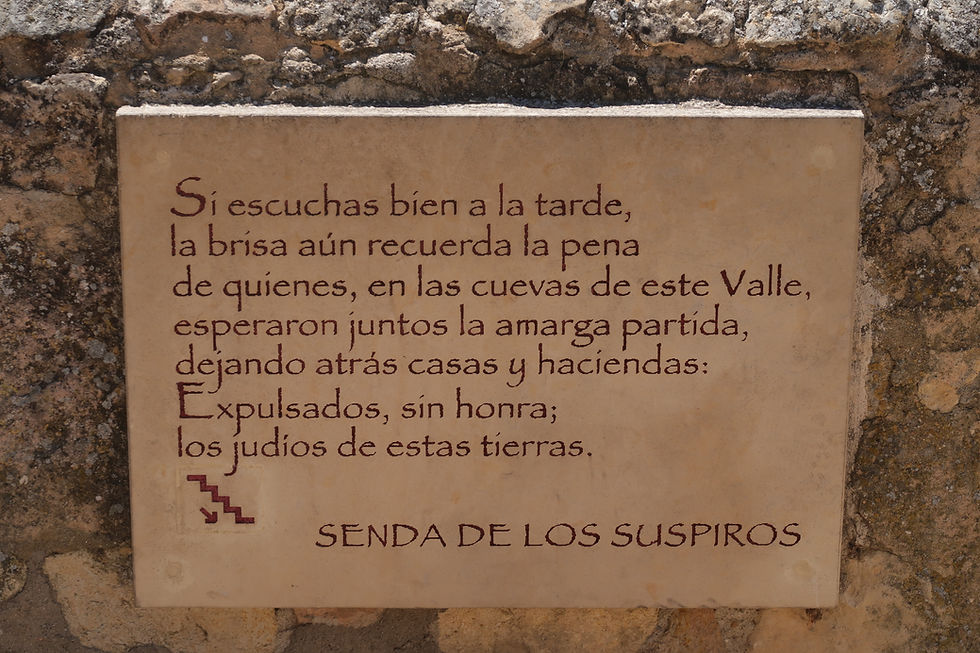
Across the city, we note countless stone tablets bearing moving inscriptions or poems. One marks the entrance to the Jewish Cemetery of Segovia. There’s a palpable sense of history in these narrow streets and alleyways, and it’s one of the most tranquil areas of the city to explore.
Sadly, the peaceful coexistence of cultures came to an end in 1474 when Isabella I was crowned queen, a coronation which took place in Segovia in the church of San Miguel, on the corner of Plaza Mayor. Within six years, Isabella and King Ferdinand II had instigated the Spanish Inquisition, targeting, torturing and executing those who did not follow Catholic teachings. By 1492 all Jews had been expelled from the city - a dark side to Segovia’s history.

Great places to eat in Segovia: our top picks part I
After an active morning, we head for Bar El Sitio, one of the most popular spots in the city. Specialising in classic regional dishes, the nod to tradition is evident in all aspects of the experience, from the wood-panelled ceiling in the bar, to the exposed stone walls and wooden shutters of the restaurant. There’s a respect for etiquette too, from the formal wear of bar staff and servers to the monogrammed napkins and wineglasses. Despite all this, it’s far from stuffy and excellent value for money.
Customers have the option of eating at high stools at the bar, or in the more formal restaurant at the back. It’s early afternoon and the place is hopping. With standing room only at the bar, we consider ourselves lucky to get the last table on the terrace. We order four dishes to share including two of their signature specialities: Judiones Granja, a rich butter-bean stew, and a portion of revolcanas, their spicy smashed potatoes. Portions are generous and many dishes are offered in half portions. It’s a perfect spot for long lazy lunches – we oblige by ordering a chilled peachy bottle of rosado – a mere €16.
El Sitio, C. de la Infanta Isabel, 9
The most popular tourist activity: The Alcázar of Segovia
On our last day, we book tickets for our only scheduled activity of the trip: a visit to the Alcázar. Perched on a rocky outcrop and surrounded by trees, this medieval castle looms over the city from every angle. It once served as the royal residence, fortress and prison, and while its origins are medieval, it was almost entirely rebuilt after a fire in 1862. There are few original features remaining and what we see today mainly dates to the late 19th century. In its mishmash of architectural styles, it’s an anomaly in this graceful city, its strange fairytale turrets resembling a set of a Disney film.
But there are a few reasons to visit, first and foremost the breathtaking views from the terrace of the upper tower. With156 stone steps to the top, it feels like ascending Everest after the World Cup celebrations the night before. But on emerging onto the vast terrace with 360-degree views, all is forgiven. Before us is a vast panorama of yellow fields, hazy blue mountains, honey-coloured buildings and lush greenery.

There are some wonderful features to admire on the interior too, including the Throne Room with its striking Mudéjar ceiling. A highlight is the Hall of Kings, with its elaborate coffered ceiling of golden geometric patterns. A remarkable frieze runs below it, featuring 52 polychrome seated figures, representing the Kings and Queens of Asturias, León and Castile.
Great places to eat in Segovia: our top picks part II
And all too soon it’s our last supper in Segovia. We head for Restaurante La Concepción on Plaza Mayor, bagging ourselves a table on the terrace with a view of the cathedral. It’s a high-end experience, with expensive heavy cutlery and monogrammed napkins.
Wait staff are highly efficient and professional but cool and charmless. It all hinges on the food - rumour has it that they serve the best Ensaladilla Rusa in the city. This creamy Spanish potato salad is one of my all-time favourite dishes and I have to concur – theirs is perfect and beautifully presented. In addition, the tortilla española is oozy and perfect, and the jamon croquettes are equal parts crispy and cheesy, a step above the norm. We order three raciones to share as it’s lunchtime, and she asks if we’d like half portions. We say no as we’re starving. Big mistake - the servings are enormous and far more than we could eat, though we do our best. We’re suitably impressed, our trip ending on a high culinary note.
And then we notice the sparrows. Like Toledo, the city is swarming with cute little gorriones but they’re even cheekier and tamer in this city, occasionally hopping onto the backs of chairs, or even onto the end of a table. We watch as one eats a crumb of bread from the hand of the man at the next table, as his wife looks on in amusement and delight. The terrace resembles a sparrow conference: they gather en-masse and it sounds as if they’re in conversation with each other, sussing out which tables to target for the best food. Some are just babies and we cannot resist their cute little faces. We shouldn’t encourage them but sneak them some food before we leave…
Bar La Concepción, Pl. Mayor, 15, 40001 Segovia
Getting there:

Segovia is 92 kilometres from Madrid. There are multiple trains a day running from Madrid Chamartín, a journey time of less than 30 minutes with fares starting at €12 one-way.
We chose to hire a car as we were travelling from Toledo. Depending on traffic, it’s a journey time of 1 to 1.5 hours to Madrid.
On-street parking is limited for non-residents in the historic centre of Segovia on weekdays, but after 2pm on Saturdays, parking is free everywhere for the remainder of the weekend. There are a number of multistory options if you're staying midweek. We used the Cathedral parking lot on one of the days with a 24-hour rate of €17. Worth noting that you can come and go as you please during this time.
If you’re traveling with a group, an alternative option is Welcome Pickups I’ve used them on multiple trips, and they offer excellent value for money and a reliable airport transfer service. Book your transfer here
And that concludes this Segovia travel guide. While it's undoubtedly a popular day-trip destination, there is far too much to see and experience in this city to not warrant a longer stay. I hope I’ve convinced you to linger a little longer.
To continue along on our travels, you can read the Madrid instalment here and why I think it just might be Europe's coolest capital. We also spent four nights in beautiful Toledo - you can read it here.
Buen viaje,
Karyn xx


Comments