


A taste of Naples: your three-day travel guide

Updated: May 19

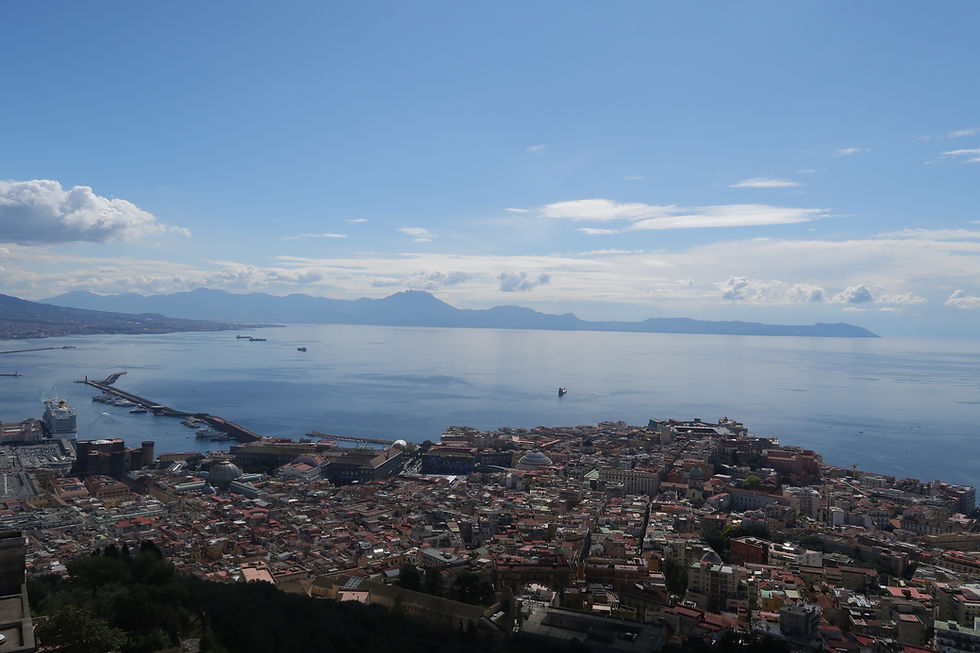
We're standing on the terrace of Castel Sant Elmo, high above the metropolis. All the noise of the city has melted away. A hazy blue light descends across the bay, and the tentative heat of the spring sun warms our faces. Down below, we trace the paths of streets walked over the previous few days. Through the labyrinth of alleyways in the Centro Storico, we spot the dome of the Galleria Umberto I. To the east, the iconic curved form of Piazza del Plebiscito. And overlooking it all is Vesuvius. Majestic. Ever-present. This is Naples.
Contents:
Disclosure: some of the links on this site are affiliate links with companies I have chosen to partner with. If you make a purchase through these, I may receive a small commission at no extra cost to you. Thank you for your support!
Naples: a three day travel guide: what to know before you go
Naples is an outlier. An Italian city like no other. Colourful and chaotic, confident in its brash energy and swagger. A city of impossibly narrow streets, bustling with life from every corner. It's noisy as hell, and unapologetically so. Everyone speaks at top volume, motorbikes zip past at great speed, and honking horns are more often a signal of intention than an expression of aggression. Cars rarely stop at pedestrian crossings so courage is required to step out as they drive around you, reminding me of Vietnam. For first-time visitors it may be an assault on the senses: unlike Rome or Venice, its appeal may not be immediately obvious but perseverance is rewarded. Napoli takes a little longer to get under your skin but when it does, you'll be hooked, line and sinker.

Why Naples is worth visiting
One of the oldest cities in the western world, Naples has a rich history dating back to its foundation by the Greeks in the 8th century BC. Less than two hundred years ago, it was also one of the most important cities in Europe: a favourite stop for visitors on their Grand Tour, lured by the art, architecture and showstopping coastal location.
We're here for all the same reasons. Culturally, Napoli is a city that punches far above its weight. Countless beautiful churches and palazzi dot the city, it's home to no less than three Caravaggios and one of the most extraordinary pieces of sculpture in the world, and there are numerous outstanding museums and galleries to while away the days. And that's before I mention the pizza, the wine, and one of Italy's most stunning settings.

For context, things only started to go downhill for Naples after the reunification (Risorgimento) of Italy in 1861 when its wealth disappeared into a centralised exchequer. Over time the local economy collapsed, its poverty creating the prime conditions for the corruption and widespread criminality which was to follow.
Associations with the Camorra are impossible to escape so I think it's important to address this from the outset. Naples has long been dogged with a reputation for being somewhat 'unsafe' for tourists but this was not our experience. Yes, parts of the city are rundown and unloved, and there may be a certain 'vibe' to some of the neighbourhoods, but there have been huge improvements since our previous visit in 2013. This time around it feels cleaner, brighter and revitalised, while never losing its authentic character. And while it requires a little more energy than other cities, the pay-off is more than worth it.

Three days in and I’m a little overwhelmed by all we’ve seen & experienced. It's hard to fathom how one city can hold so much beauty, art and culture, and we've barely grazed the surface. History is all around us and every building tells a story, each flaked-paint palazzo offering a fascinating glimpse into the past. There are parts of the city that feel entirely untouched by modernity. Laundry is strung from every balcony and as we wind our way through the labyrinth of the old town, doors are open onto the streets offering glimpses into the domestic lives beyond. Living rooms and bedrooms in one, with holy pictures illuminated from below. What we may consider kitsch in today's world is very much a fabric of every day life in Naples.
We're here to meet up with old friends from Canada. It's their first time in Italy and they're travelling with their eight year old son. Each evening at dinner I'm struck by the warmth of the waiters and how they engage with this little boy. They pat his head and crack jokes with him, smiling at his cute Italian accent as he asks each evening for his favourite dish, pasta al pomodoro.
Neapolitans can initially come across as wary and perhaps a little abrupt in manner, particularly the older generation. It's worth remembering that the people of Naples have had to overcome more challenges than most, and have shown great resilience and courage in the face of adversity. However it made me smile to see how that wariness entirely dissipates in the presence of children.
Naples in three days: the unmissable highlights

My appetite for Naples had been whetted by the wonderfully absorbing Napoli Unplugged: Guide to Naples. Not your usual travel guide, this book is more of a travel companion, full of stories and small details which really bring a city to life. With just three days to explore, we make our peace with the fact we're not going to see everything that we've earmarked for this trip but some things are non-negotiable. Top of our list is a sunset stroll along the Lungomare, a 3.5km stretch of seafront promenade which hugs the Bay of Naples.
Lungomare and the Bay of Naples

The curve of the bay forms a natural amphitheatre making this the place to come for ringside seats to the most iconic views of Naples. Bookended by the 12th century fortifications of Castel dell'Ovo to the east and Lungomare Mergellina to the west, this stretch of promenade is popular with walkers, runners and cyclists alike. The route starts from Via Nazario Sauro, merging onto Via Partenope and finally Via Caracciolo which runs along the length of the Villa Communale, a scenic green space lined with trees and sculptures.
NB: it's worth noting that at the time of our visit in March 2026, there are major redevelopment works in progress and some sections of the waterfront are no longer accessible to pedestrians.

It's golden hour as we make our way from Piazza Municipio to the waterfront. The peaks of Vesuvius dominate the skyline, a view that will never get old. The sky is really putting on a show, ablaze in shades of pink and purple. Across the water the Sorrentine peninsula and the islands of Procida, Ischia and Capri are glowing in the late evening sun.

The monumental Fontana del Gigante (Fountain of the Giant) marks the start of Via Partenope and one of the most picturesque sections of the Lungomare. Dating to the 17th century and constructed from white marble, the decoration is lavish and classically inspired.
This part of the city is home to some of Naples' most exclusive hotels including The Excelsior, the Santa Lucia, the Royal Continental and the Grand Hotel Vesuvio. With rooftop terraces and panoramic views, this is where I want to stay next time when I return to Naples.
Some trivia for Sopranos fans. If the fountain and Hotel Excelsior look familiar to you, you are eagle-eyed and correct. This area was one of the main filming locations in season 2. In Commendatori, episode 4, Tony, Paulie and Christopher head to Naples and stay in the The Excelsior. across the road from the Fontana del Gigante. The episode features many sweeping views of Vesuvius and across the bay.

There can be few better spots to enjoy a sunset or sunrise in Naples than the Lungomare. We make it just in time before the sun begins to sink behind the buildings. It's peaceful down here, away from the honking of horns and the noise and chaos of the city. The promenade is lined with bars, restaurants and, of course, gelaterie for the all-important Italian ritual, the passeggiata.
Our last stop before darkness falls is the Villa Communale, a fabulous public garden with fountains, classical sculptures and a terrific playground for kids.
Castel Sant' Elmo: for the best views of Naples from above

If there is one place everyone should visit in Naples, it's Castel Sant' Elmo, high in the hills above the city. This immense star-shaped medieval fortification on Vomero hill is visible from almost every part of Naples. Visitors come here to drink in the spectacular 360 degree views from the wraparound terrace - all for a mere €5.

Standing on the terrace, we pick out the city landmarks encountered on our visit so far. The unmistakable Spaccanapoli (literally the Naples splitter), the long and narrow main street that cuts through the historic center, dividing it in two. The glass and vaulted dome of the beautiful Galleria Umberto I, the 19th century shopping arcade. The palace on the hill to the north at Capodimonte. The countless church spires. The arcaded walkways of Piazza del Plebiscito.
A winding cobbled walkway leads from ground level to the rooftop terrace. Every turns brings a different vantage point: a new perfectly framed image of dazzling beauty.

On the rooftop is one of the few examples of the work of Mimmo Paladino, one of my favourite contemporary Italian artists and sculptors. The entrance fee also includes access to the Novecento Museum with over 170 works by 20th century Neapolitan artists.
A self-guided audio tour is recommended for greater insight into the castle and its history.
Castel Sant' Elmo, Via Tito Angelini, 20/A
Get lost in the streets of the Centro Storico

Piazza del Plebiscito is a setting that will be familiar to fans of My Brilliant Friend (l'Amica Geniale), the seductive TV adaptation of the four Neapolitan novels by Elena Ferrante. Used as car park from the 1960s until the mid 90s, it forms a raucous backdrop in some of the series' city-based scenes. These days, thankfully, things are a bit quieter. Home to the neo-classical Royal Palace and the magnificent San Francesco di Paola Basilica, this vast pedestrianised square is one of the city's most iconic landmarks. Recognisable for its curved arcaded walkway and equestrian statues, the piazza is one of the largest in Italy and is often used for major events or concerts. When not in use, the local kids made good use of its vast space to try out their best Maradona moves.
All roads lead from here and it's excellent spot to visit nearby places of interest. Next stop: Galleria Umberto I
This beautiful 19th century shopping arcade is a photographer's dream. Topped with a monumental glass dome and boasting four vaulted glass wings, by day it's filled with light, and by night it's one of the city's most atmospheric public buildings. Designed to emulate the original Galleria Vittorio Emanuele II in Milan, it served a similar function: to provide a covered walkway from Teatro San Carlo to Via Toledo , sheltering the well-heeled from any adverse weather conditions. The tiled floor is particularly stunning, highly polished with elaborate mosaics.

Within walking distance are two of Naples' most distinguished theatres, Teatro San Carlo and Teatro di Napoli, known as Teatro Mercadente. Both date to the 18th century with horseshoe-shaped auditoriums and boasting opulent interiors to transport you back in time. Teatro San Carlo was the first royal opera house of its kind in Europe, pre-dating the illustrious La Scala in Milan by some forty years. With a lavish frescoed ceiling, sumptuous red and gold décor and six levels of theatre boxes on three sides, an evening spent here is always going to be a worthy experience. And if, like us, your visit doesn't coincide with a performance, a guided tour of the building comes highly recommended. There are six per day, two in English, lasting 30 minutes in total - times can be found here. Unfortunately access was restricted to the building for a week throughout our stay, so guided tours had been put on hold. Another reason to come back.
An artistic voyage underground in the Metro stations of Naples

I don't tend to linger in Metro stations but in Naples, being underground is a different experience. The Metro Art Napoli project has transformed the subterranean spaces into one vast public art exhibition space. The so-called Art Stations of Line 1 and 6 showcase more than 300 site-specific works of contemporary art, including contributions by renowned artists like Mimmo Paladino. The Toledo station in the Spanish Quarter is a stunner with a cylindrical opening to the sky, its turquoise and blue mosaics evoking the sensation of descending below the sea. Like an excited child, I travelled up and down the escalator multiple times to fully experience the effects. For video footage, check out my Instagram Stories here
The Artistic Metro Stations of Naples: Modernity & Antiquity guided tour can be booked here
Naples: a city of cultural masterpieces
No visit to Naples is complete without a visit to the Veiled Christ at Sansevero Chapel.

The unassuming chapel is home to one of Naples' most astonishing works of art, and is unsurprisingly one of the most popular sites in the city. The Veiled Christ or Cristo Velato is the work of sculptor Giuseppe Sanmartino. Dating to 1753. it showcases a virtuosity in marble like I've never seen before. The figure of Christ lies in repose at the heart of the small chapel. His head rests on two pillows, leaning to one side, while his body appears to sink into the bed below. In death, his face is still and peaceful. A sheer veil covers his face and drapes his torso. Through the thin material the contours of his body are exposed, and the holes in his hand bear testament to his recent suffering. It's utterly extraordinary, even more so when you consider that it was carved from a single block of stone.
While the Veiled Christ is undoubtedly the highlight, it would be remiss to ignore some of the other remarkable works of art dotted around the chapel. The visionary Raimondo di Sangro, Prince of Sansevero in the mid 18th century, commissioned some of the most illustrious artists of the day to contribute to his family chapel. Of particular note is the remarkable veiled figure of Modesty by Antonio Corradini to the left of the altar, and the jaw-dropping Disillusion by Francesco Queirolo to the right. Even the net in which the figure is draped is carved from marble.
Behind the altar, a series of sculpted putti surround a painting of the Pietà. Holding onto the top of the frame for balance as they peer over it, the artist has blurred the boundaries between painting and sculpture.
Above the entrance door is another brilliant example of blurred boundaries between art and reality: of a moment of action captured in stone. A figure climbs out of a tomb, the lid held open by a griffin. One leg has already stepped out into our space.
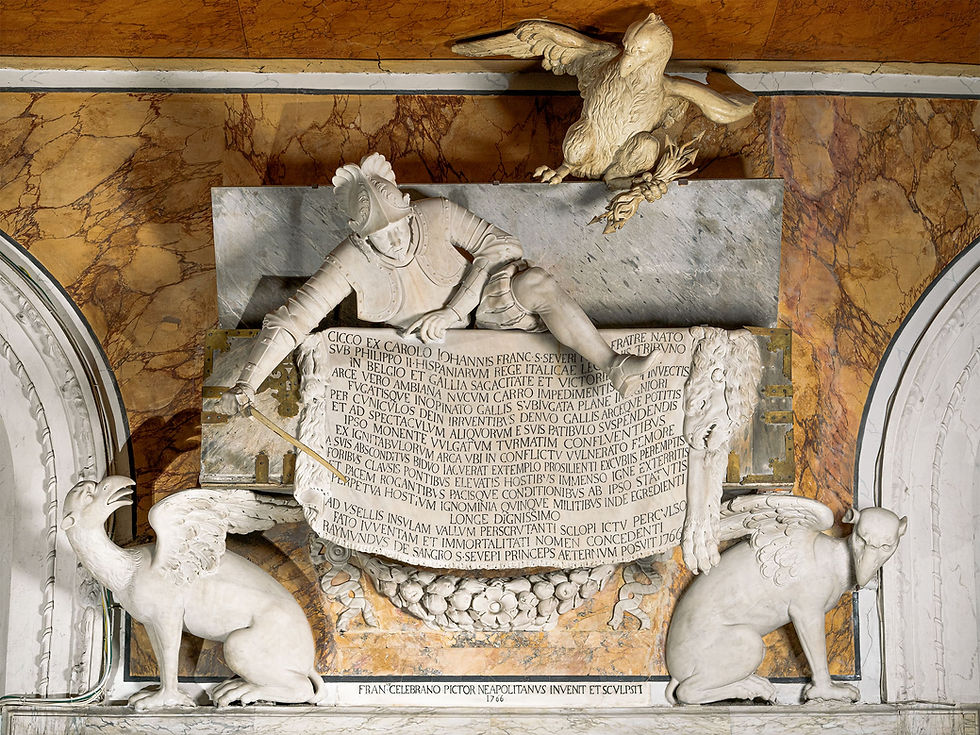
Worth noting: Photographs are not allowed in the chapel, and this is strictly enforced. I think this is a good thing. In a world where we frequently reach for a camera before pausing to fully take in what we're looking at, it encourages a more mindful approach to art appreciation. We walk slowly around the artworks with a heightened awareness of all the small details.
Tickets and tours: As one of the most popular sites in the city, pre-booking of tickets online is recommended. Tickets are allocated for specific timeslots of approximately 30 minutes and cost €12 for a standard adult ticket. It's worth considering a guided tour with a local expert to really bring all the small details of the chapel to life before your eyes. Book your tour here.
Where to find it: Sansevero Chapel, Via Francesco de Sanctis, 19/21
Google Maps link here
Jago Museum and the extraordinary Veiled Son

So you'd probably heard of the Veiled Christ, but have you heard of the Veiled Son? Well no, neither had I until very recently when I was fortuitously introduced to the work of Jacopo Cardillo, AKA Jago, a remarkable young Italian sculptor. He works with marble in the classical style, referencing the great masters like Bernini and Michelangelo while adopting a contemporary approach. His subject matter is unquestionably political, addressing issues such as racism, misogyny and societal inequality.
The Jago Museum opened in 2023 in the Church of Sant’Aspreno ai Crociferi, a magnificent 17th century building in the heart of the Rione Sanità. According to our tour guide, this was once a no-go area, a crime-ridden and dangerous part of Naples. These days, it's colourful and noisy, its narrow streets lined with markets selling food, clothing and knick-knacks. There's still a perceptible vibe in the air and it's mainly frequented by locals but the presence of the museum and its draw for tourists has gone some way to altering perspectives of this neighbourhood.

The museum turns out to be one of the highlights of our trip. Inside this beautiful space we find a staggering selection of sculpture showcasing his virtuosity and skill in working with stone. He's managed to capture the deepest of human emotions and vulnerabilities in marble, and the most harrowing of scenes. In Aiace and Cassandra, he takes us back to the Trojan War and the rape of Cassandra by Ajax. Her face is frozen in a scream as she fights back against her aggressor, her hand pushing him away, her fingers sinking into his flesh. It's utterly extraordinary.
In his interpretation of the Pietà, he references a photograph taken by photojournalist Manu Brabo during the war in Syria. A father holds the lifeless body of his child, his face a mask of grief and loss. It's a heartbreaking scene, full of emotion and utter devastation.
There are far too many other highlights to mention here but it's enough to say that each piece is filled with soul and has a story to tell . Taking a tour is highly recommended.
Our tour guide is part of La Cooperativa La Sorte, Naples’ first community cooperative. Their mission is to revitalize neglected artistic heritage sites and churches while simultaneously upskilling local young people for careers in the art and tourism sectors. It's such a great initiative and her passion for the museum and for the area was infectious, really bringing the artworks to life for us.

Arguably the artist's most famous piece is Figlio Velato: the Veiled Son. You won't find this in the Jago Museum but in a small innocuous chapel a short walk away. As with the iconic Veiled Christ in Sansevero, the child's lifeless body is laid out on a marble slab in the centre of the church. Illuminated from above, all of the contours of his tiny body are visible through a transparent veil that covers him from head to toe. It's a devastating commentary on the suffering of innocents and the consequences of the political decisions taken by the powers that be.
Worth noting: Visits to the Veiled Son sculpture are not sold individually but included as part of the entrance ticket to the Jago Museum - €10. The ticket includes a 30 minute tour in either Italian or English, depending on the time of day, and is well worth doing to fully understand the artist's process and the stories behind each piece. Visitors must first visit the Jago Museum to validate their ticket, and then proceed to the Cappella dei Bianchi, a seven' minute walk away, to see the Veiled Son. For some reason, it's not possible to do this in reverse. The ticket also offers concessions to the Catacombs of San Gennaro.
Where to find it:
Jago Museum, Church of Sant’Aspreno ai Crociferi, Piazzetta Crociferi, 4 - Google Maps link here
Veiled Son, Cappella dei Bianchi, Basilica di San Severo Fuori le mura, Piazzetta San Severo A Capodimonte. Google Maps link here
In search of Caravaggio: master of light, shade and drama

Naples is home to not one but three extraordinary paintings by the Baroque master Caravaggio. Both revered and reviled, this controversial character is considered one of the greatest artists of all time and rightly so. His stark and unflinching realism, his complete disregard for the rules of Classical convention, his cinematic ability to capture a moment of drama in time, and his complete mastery of light and shade has inspired thousands of artists to this day.
It's always a treat and an emotional experience to see a Caravaggio in real life. To see three of them in three days is a privilege. First up is a trip to the Pio Monte della Misericordia, a magnificent 17th century palazzo and adjoining church which ahowcases his monumental Seven Works of Mercy. The painting is housed in the space for which it was originally commissioned and is an absolute tour-de force, both in terms of composition and subject matter, if not also a little disturbing. You can read more about it here.
Seven Works of Mercy, Pio Monte della Misericordia, Via dei Tribunali
Tickets: €10 standard adult. Full pricing details here

Museo di Capodimonte is located on a hill to the north of the city, surrounded by acres of lush greenery and woodland. With a vast and impressive collection including works by Titian, Botticelli and Raphael, it's the Caravaggio that I'm drawn to yet again. Brutal in its realism, the suffering and resigned acceptance of the central figure is illuminated sharply, while his aggressors emerge from the darkness. The three figures occupy the full picture plane, bringing us, as viewers, into the heart of the action.
The Flagellation of Christ, Museo di Capodimonte, Via Lucio Amelio, 2
Tickets: €15 standard adult ticket
Last but not least is the The Martyrdom of Saint Ursula, the last painting ever completed by the artist before his death in 1610. Given pride of place on a feature wall in a darkened room in the Gallerie d'Italia, it's got all the trademark Caravaggesque features we've come to expect: the closely cropped composition bringing us closer to the action, the dramatic, almost cinematic lighting, and the unmistakable face of the artist himself as one of the onlookers to the saint's murder.
The Martyrdom of Saint Ursula, Gallerie d'Italia, Palazzo del Banco di Napoli, Via Toledo, 177
Gallerie d'Italia: an unmissable treasure trove in the heart of the city centre
The Caravaggio is not the only reason to visit the Gallerie d'Italia. Located in the former Banco di Napoli, It's a wonderful museum on one of the city's main thoroughfares. The 1940s building itself is striking in its pared-back detailing: a grey stone and marble façade with grand arches and large windows, filling the space with light. Fans of Neapolitan filmmaker Paolo Sorrentino may recognise the building from his 2021 masterpiece The Hand of God. It's the workplace of the protagonist's father, played by the wonderful Toni Servillo.
The art collection is astoundingly good. If you're short on time, concentrate your attention on the first floor covering the period from the early 17th century up to the early 20th century. Featured artists include Luca Giordano, Artemisia Gentileschi and of course, Caravaggio.
Discovering the work of Vincenzo Gemito is a particular highlight for me. This 19th century Neapolitan artist was a master sculptor and draughtsman, and an entire gallery of his work stopped me in my tracks. A series of busts and children's heads in terracotta and bronze are beautifully illuminated to showcase his exquisite attention to detail.
Gallerie d'Italia, Palazzo del Banco di Napoli, Via Toledo, 177
Standard adult tickets: €7 Buy online here
Cloister of Santa Chiara: an oasis of tranquility in the heart of the city

Located through a side entrance of the church of Santa Chiara is the peaceful Cloister of Santa Chiara. The church was bombed during World War II and has been rebuilt in its original Gothic style, with an austere interior. By contrast, the cloister is a feast for the eyes; the walls of its arcaded walkways adorned with 17th century frescoes, and its pathways lined with majolica tiled pillars decorated with garlands of leaves, flowers and fruit.
The walkways surround a central garden with a fountain, lined with lemon and orange trees. I particularly love the vibrant scenes of everyday life running along the base of the pillars and on the tiled seats.
Cloister of Santa Chiara, Via Santa Chiara 49c
Eating and Drinking in Naples

If you're a pizza fan, let's face it you're going to be eating at least one every day. In this city, pizza making is a craft; part of the fabric of their culinary society and therefore, it's almost impossible to have a bad one. Here's it's all about simplicity, the perfect base and the quality of ingredients. And despite the increasing numbers of visitors to Naples, the value for money to this day is still excellent. Expect to pay less than €10 for a Margherita.
While you can take your chances on the streets, some places are better than others. Most visitors will head for the famous L’Antica Pizzeria da Michele, considered one of the best in the city for generations. While it doesn't look much from the exterior, it's now a huge draw for tourists, thanks to its starring role in Hollywood's Eat, Pray. Love. Expect queues at all times.
L’Antica Pizzeria da Michele, Via Cesare Sersale, 1, 80139
Lombardi 1892
But you don't always have to follow the crowds and go where the tourists go. If, like us, you prefer your pizza dining experience to be influencer / Instagrammer free, then it's worth seeking out the ones that are a little off the main tourist drag. Tip: the AVPN (Associazione Verace Pizza Napoletana) website has a list of members' pizzerias who are accredited producers of true Neapolitan pizza and have undergone quality certification. Featuring on this list is a guaranteed stamp of excellence - you can search under Napoli for a full list of AVPN pizzerias here
Our personal favourite is Lombardi 1892, just around the corner from the Jago Museum. And yes, it's on the AVPN list. Like all the best places, it's not fancy with old-fashioned but charming decor, and one small woodfired oven which can only cook one or two pizzas at a time. It's not the place to come if you're in a hurry. It's a proper authentic Neapolitan experience: a place to sit and sip your drinks, to chat to the waiters and to absorb the rich tapestry of life that surrounds you.
To this day it's still the best pizza I've ever eaten. Just four ingredients: mozzarella, tomato, basil and ricotta, on a thin, perfectly crispy base. The wine list is comprehensive and excellent value for money with the majority of bottles priced under €26.
Lombardi 1892, Via Foria, 12/14
Pizza with a view at Piazza San Domenico Maggiore
At the heart of the Centro Storico and a short walk from Sansevero Chapel is the grand Piazza San Domenico Maggiore. The Spire of San Domenico is its main focal point, one of three beautifully sculpted obelisks in the old town. On all sides, the piazza is beautifully framed by elegant palazzi. A pizzeria catches our eye, with a terrace overlooking the square, and we manage to bag ourselves a table with a view.

Palazzo Petrucci Pizzeria is the location of our first lunch in Naples and it's a good one. A stylish contemporary space with friendly staff, it feels a little more upmarket than many other places but the pizza is a knock-out - artisan, wood-fired pizza with some innovative topping combinations. Great wine list too, and the coffee is excellent.
Palazzo Petrucci Pizzeria, Piazza S. Domenico Maggiore, 5/6/7
Sartù restaurant

We manage to have one full meal on our trip that doesn't involve pizza. On a recommendation from friends, we book a table at Sartù, an upmarket restaurant in the leafy Vomero area, close to where we are staying. It's a Sunday evening and we're their last customers, arriving late due to a delayed flight. Nonetheless, we're made to feel welcome, and never once feel rushed. Mellow jazz is playing in the background and the walls are lined with modern prints and jazz album covers.
We tuck into starters of meatballs and an unusual but delicious parmigiana with broccoli, followed by comforting bowls of lagane e ceci, pasta with chickpeas in a creamy stock, on a bed of pesto and topped with crunchy onions. It's divine.
We'd like some wine from the region and ask the waiter for his advice. On his recommendation we opt for a bottle of Piedirosso, a single grape variety from the Campania region. It's smooth and soft, and goes down a treat with the food. It becomes our wine of choice for the rest of the trip.
Sartù restaurant, Via S. Gennaro al Vomero, 13
Stop for a nightcap at Cordiale

Just a short walk away from Sartù is Cordiale, our favourite bar of the trip. Ultra-cool but tiny, it opens onto the street with just a few tables, both inside and out. Craft beer lovers will be in heaven, with an entire wall lined with interesting options to choose from, but they also have cocktails and a small but decent selection of wines by the glass. The atmosphere is chilled out, the staff member is friendly and the tunes are great. It's a vibey little spot.
Cordiale, Via Filippo Cifariello, 2a
Wine Experiences in Naples
I’ve recently partnered with Winedering, an online marketplace for wine tourism across key destinations in Europe. Not all wine tours are created equal and as a wine and food lover, I’m always on the lookout for experiences that are thoughtful and carefully considered. With Winedering, I was immediately struck by their careful curation of unique food and wine experiences, including tastings, vineyard tours and wine bar experiences for when you don’t want to leave the city. I wasn't at all familiar with wines from the Campania region before arriving in Naples, but really enjoyed the opportunity to sample unfamiliar reds like Aglianico and Piedirosso. Check out some of their top city wine experiences below...
If you need more convincing, check out some of their reviews here
Where to stay in Naples
Get away from it all in leafy Vomero
Daymoon House, Merliani - Self-catering apartment - sleeps 4.
On a recommendation from friends, we opted to stay out of the city centre in the quieter hilly neighbourhood of Vomero to the west. It's the perfect option if you want to leave the noise and chaos of the city behind at the end of the day. We rented a two-bedroom apartment, close to the Quattro Giornate Metro stop (Line 1) with easy access to all the city's main sites. The apartment is pretty basic, but clean and comfortable with a large kitchen, and bathroom with bath and shower. It's approximately a 10 minute walk to Castel Sant' Elmo with the best views of the city.
It's also great value for money - €346 for three nights as of March 2026, and sleeps four in two double beds.
Daymoon House, Merliani, Via Giovanni Merliani, 143

Mid-range stays
On our previous visit to Naples, we stayed in the beautiful Palazzo Caracciolo Naples, close to the Jago Museum and Lombardi 1892. The clue is in the name - located in an elegantly restored historical palace, its inner courtyard is an oasis of calm, despite its proximity to some of the city's buzziest streets.

Bedrooms have calm, restful tones, and I still remember how luxurious and comfortable the bed was. The hotel also has a spa and wellness area. While it's a little more expensive now than when we first stayed there, it's worth the money. One of our all-time favourite hotels.
Palazzo Caracciolo Naples, Via Carbonara, 112
Other mid-range recommendations:
Relais Della Porta, Via Toledo, 368
Location-wise, it couldn't get more central than this. With beautiful herringbone floors, plush rooms and contemporary furnishings, it's a comfortable stay within walking distance of everything.
Real Paggeria, Via Solitaria, 39
Elegant, pared-back Scandi décor and thoughtful attention to detail creates a restful environment for downtime and sleeping. Another great location, just minutes from Piazza del Plebiscito and the beautiful Galleria Umberto I.
Luxury stays
Splurge on a hotel with a rooftop terraces and panoramic views. Naples' seafront, the Lungomare, is home to some of the city's most exclusive hotels including The Excelsior, the Santa Lucia, the Royal Continental and the Grand Hotel Vesuvio.
Getting there
Fly direct with both Aer Lingus and Ryanair from Dublin and UK airports. (note flights are seasonal and don't operate all year round).
Getting to Naples city centre from the airport is a breeze. The Alibus shuttle service operates between the airport, central station (Piazza Garabaldi) and the port every 15 minutes, from 5:30am to midnight every day. Tickets cost €5 one way and can be purchased on board, or online in advance using the Unico Campania app. Full details here
Getting around the city: public transport
Naples has an excellent and affordable public transport network including Metro Lines 1 & 6, funiculars, buses and trams. Services are operated through ANM. Download the Unico Campania app to purchase single tickets at €1.80, day tickets at €5.40 or three-day tickets at €10.80 (prices as of March 2026)
Car Hire
If you're brave enough to drive a car in Naples, you're my hero. It's an extreme sport, streets are impossibly narrow, rules of the road are a mere suggestion, and parking is at a premium. But if you do decide to, we always use Discover Cars Rates are the cheapest online and they compare prices across 700 suppliers.
Traveling with a group of friends?
Welcome Pickups offers excellent value for money and a reliable airport transfer service. Book your transfer here
Naples is the perfect location to explore a little further afield. Pompeii and Herculaneum are within easy reach by train, and the Amalfi Coast is at your fingertips. We extended our trip south on our previous trip to Naples. You can read about our highlights of the beautiful Amalfi Coast here.
If you're planning a longer trip and terrified of driving, Italy's main cities are very well connected by rail, with reasonably priced fares too. Omio is my go-to site of choice for train bookings: it's user-friendly and allows you to compare prices for trains and buses across Europe. Book here.
And that concludes my whistlestop three day travel guide to Naples. We've barely scratched the surface and are already itching to spend at least another full week here to fully experience all this city has to offer. We leave with plans to book a return trip in the foreseeable future.
Buon viaggio,
Karyn xx


Comments